AI vs Automation – What’s the Difference and Which Does Your Business Actually Need?
Most business owners use these words interchangeably. They mean very different things. Here is the clearest explanation — and exactly which one your business needs right now.
Quick answer
The difference between AI and automation is this – automation follows fixed rules you set in advance, while AI learns from data and makes decisions on its own. Automation is rigid and predictable. AI is flexible and adaptive. Most small businesses should start with automation for simple repetitive tasks, then add AI when they need the system to think, personalize, or adapt. In 2026, the most powerful business systems combine both.
If you have ever searched “AI vs automation” or wondered what the actual difference is — you are not alone. A 2026 survey found that 67% of small business owners admit they use the terms interchangeably without fully understanding the distinction.
This matters because choosing the wrong approach wastes money. Buying AI when you only need basic automation is expensive. Buying basic automation when you need AI means building something that breaks every time your business changes.
This post gives you the clearest possible explanation of both — with real examples from businesses like yours — and a simple framework to decide which one your business actually needs right now.
The Clearest Explanation of Automation
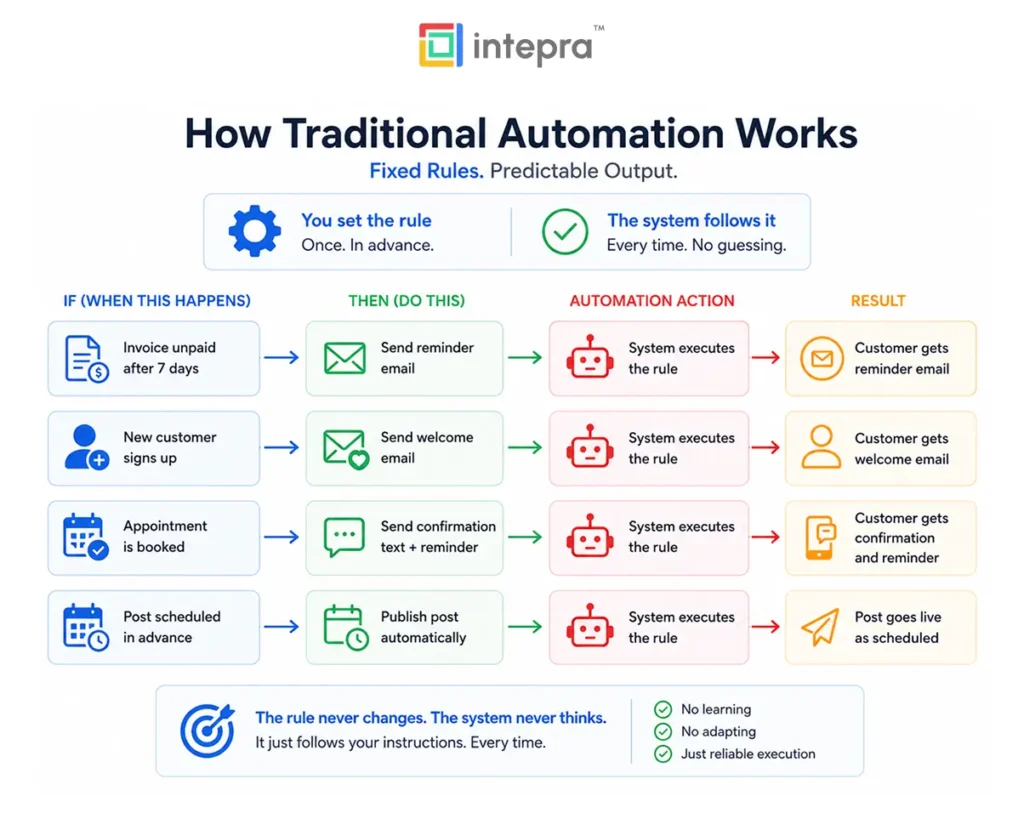
Automation is simple. It follows rules you define in advance.
You tell it: when this happens, do that. Every time. No exceptions. No thinking. No adapting.
Here are real examples of automation in a small business:
Notice the pattern. Every single example above does the same thing every time. The rule never changes. The system never learns. It just executes.
This is automation. It is powerful, reliable, and affordable. And for many small business tasks — it is all you need.
The Clearest Explanation of AI
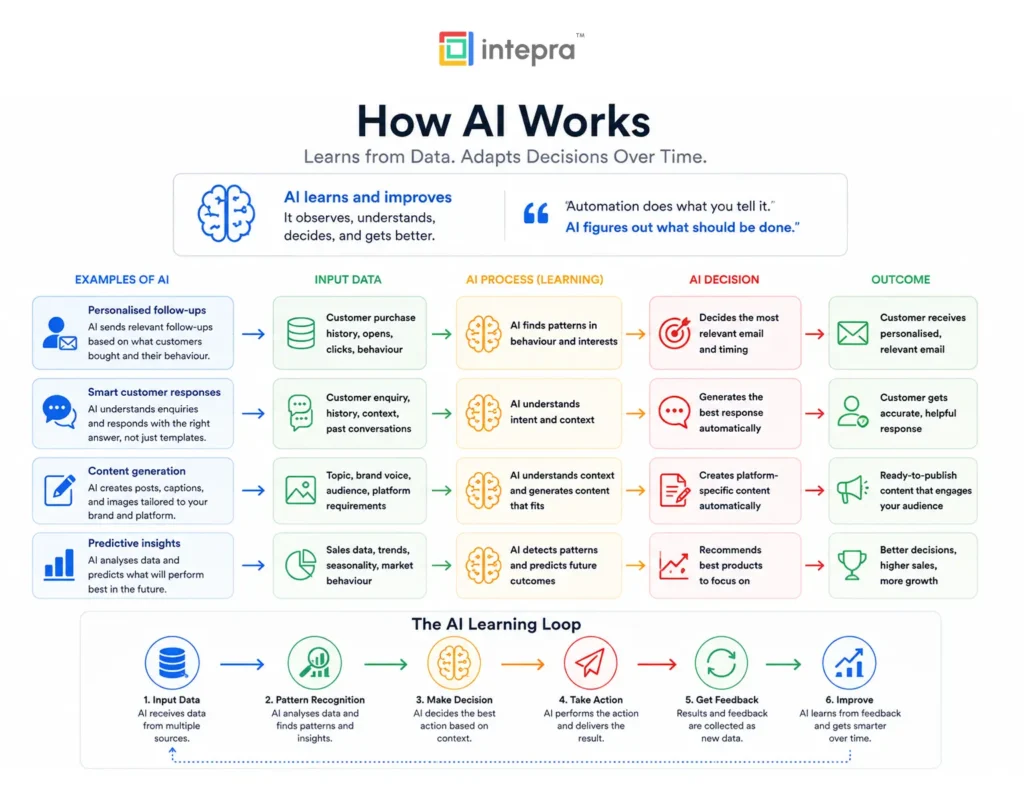
AI — artificial intelligence — is different in one fundamental way. It does not just follow rules. It learns from data and makes decisions based on context.
Instead of you defining every rule in advance, the AI observes patterns, understands context, and decides what the best action is — often better than a fixed rule would.
“Automation does what you tell it. AI figures out what should be done.”
Here are real examples of AI in a small business:
Notice the difference. Every AI example requires judgment. The system is reading context, making decisions, and adapting its response. No fixed rule could handle these tasks reliably.
AI vs Automation – Side by Side
VS
Which One Does Your Business Actually Need?
Here is the honest framework. Use this to decide exactly where to start.
| Your Situation | What You Need | Example |
|---|---|---|
| Same task done the same way every time | Automation | Invoice reminders, appointment confirmations |
| Responding to customers with different needs | AI | Customer support, personalised follow-ups |
| Scheduling social media posts in advance | Automation | Post scheduling tools |
| Creating social media content automatically | AI | Intepra Post Creator |
| Sending the same email to all new customers | Automation | Welcome email sequences |
| Personalising emails based on customer behaviour | AI | AI-driven email personalisation |
| Running complex business workflows end to end | Both Together | Full AI automation systems |
The Smart Starting Point For Small Businesses in 2026
Here is the approach that gives small businesses the fastest return in 2026.
At Intepra we build exactly this – custom systems that combine automation and AI specifically for your business workflows. We identify what to automate, where to apply AI, and build the entire system so you do not have to figure any of it out yourself.
And for social media specifically – Intepra Post Creator uses AI to generate platform-specific posts and images across LinkedIn, Instagram, Facebook, X, YouTube, and Pinterest in under 15 seconds. That is AI and automation working together in one tool.